
Pan No. 304220016
Social Welfare Council No. 21275
District Administration Office Registration No. 512-2063/064
Social Welfare Council No. 21275
District Administration Office Registration No. 512-2063/064


www.tsumvalley.org
Supporting Education, Health, Sanitation and Environmental Awareness in Tsum Valley
The Tsum School Project (TSP) was initiated in fall 2009, when Mr. Sonam Lama (an architect in Kathmandu who was born and raised in Tsum Valley) led a trek for three Americans who had been asked to provide input regarding trail conditions, routing, signage, future campsites, guesthouse locations and a detailed trek itinerary in Tsum Valley.
This three-week exploratory trip was conceived and supported by Mr. Jyoti Adhikari (past president of TAAN…the Nepali National Trekking Association) and his professional team of guides, cooks and porters from Eco Trek International in Kathmandu.

.jpg)
.jpg)
.jpg)
To be eligible for such benefits, however, each Tsum school must help conduct and maintain a trash collection program onsite and in their village. This arrangement will increasingly provide greater benefits for Tsum Valley, including healthier and more sanitary conditions due to trash management, better nutrition for qualifying school students, cleaner appearances to enhance the valley's outstanding natural beauty and encourage tourism, and…most importantly…a better education for Tsum students.
.jpg)
Education Background of Tsum Valley
In 1974, the late Nepali ruler King Birenda visited the valley and found that most Tsum children received no formal schooling, while a small handful of children from wealthier or more educated households had to walk many days and find accommodations away from home to receive schooling in distant cities (the district headquarter city of Gorkha or the far distant capital city of Kathmandu). Unfortunately, after receiving a higher education, most of these students elected not to return and help encourage greater educational efforts in Tsum.
Accordingly, King Birenda ordered two schools to be built in upper Tsum Valley (Chhekam and Buddha Primary schools). Since then, the number has grown to eight primary (elementary) schools throughout Tsum Valley.
In addition, the Tsum Welfare Committee (TWC) was established in 1990. This is a local Nepalese non-profit organization whose mission includes social and educational development in Tsum Valley. They are a key partner in this project.
Scope
Initially, the Tsum School Project will focus on providing uniforms and basic educational materials for three primary schools (grades 1-5) in upper Tsum Valley (Chhekam, Buddha and Chhule-Nile). Eventually, it is designed to also include educational materials, school supplies, scholarships and lunches for most students at all primary schools in both upper and lower Tsum Valley.
Can You Help?
Nepal is the poorest country in Asia, so any contributions we receive...be it financial or in the form of childrens books (new or used) or school supplies...really go a long way here. Working as foreign volunteers in conjunction with a local Nepali non-profit (the Tsum Welfare Committee, who also covers all administrative and material transport costs in-country), we secure school uniforms and educational materials in Nepal quite inexpensively (only about $30 student). We also have the school uniforms made in Kathmandu and transported to Tsum Valley by local porters, both of which provide much-needed employment for local Nepali workers.
Contributions Are Appreciated!
To provide educational opportunities and hope for Tsum primary students, we ask for your help. A savings account has been established by American trekkers Linda Chitwood and Jack Moore in Mt. Shasta, California.
Any financial contributions can be made directly to either Linda Chitwood or Jack Moore, with "Tsum School Project" noted on the memo line, and mailed to:
Tsum School Project
P.O. Box 212
Mt. Shasta, California
96067
For more information, please contact:
Linda Chitwood
Linda@chitwoodenergy.com
(530) 926-3370
or
Jack Moore
jackaway@hotmail.com
(530) 926-2600
In Nepal, a Tsum School Project savings account has also been established by the Tsum Welfare Committee. Funds can be wired to them as follows:
Account Name: Tsum Welfare Committee
Account Number: 10203274
Bank Name: Lumbini Bank
Bank Address: Durbarmargh, Kathmandu, Nepal
P. O. Box: 11007
Phone No: ++977 1 4243165 / 4243158
Fax: ++977 1 4227590
SWIFT Code : LUBLNPKA
Email: info@lumbinibank.com.np
Principal Partners in the Project
Tsum Welfare Committee (TWC)
Mr. Sonam Lama, architect and social planner, former resident of Tsum Valley. Former secretary of TWC
Linda Chitwood and Jack Moore, American trekkers and volunteers
You...our supporters!
A Nepali's Perspective of Trash
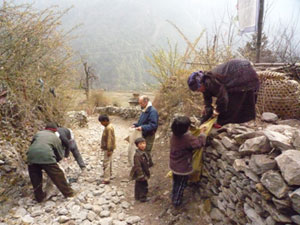 Plastic and foil packaging appeared fairly recently in Tsum Valley. When discarded as trash, these wrappers not only diminish the attractiveness of this pristine valley, but also create environmental, health and sanitation problems. Each year, for example, many Tsum people travel to high alpine meadows near the Tibetan border to harvest medicinal plants called yarsagumba (Cordyceps sinensis, a caterpillar fungus also known as Himalayan Viagra). This is a major source of income for them, but also creates trash in pristine environments, since these people don't understand that modern trash doesn't degrade like traditional organic trash (such as leaves, yak dung, food scraps, etc.).
“When I was younger, I liked all the new colorful and shiny plastic and foil wrappers. We would play with them and admire them, even when they were discarded on the ground. We valued them because they came from exotic far-away places and represented a new and exciting technology,” recalls Sonam Lama of Tsum Valley. "In hindsight, of course, our perception of these items as trash was different than that of visitors and trekkers. Now we understand that trash is bad for animals, our health, the climate, our tourism trade and the overall environment, and know we must address this problem...therefore we are excited about the Tsum School Project."
